- How to Successfully Start Chili Pepper Seeds
- When should you start chili pepper seeds?
- Choosing the right seeds
- Required equipment
- Which substrate should you use?
- Ideal germination temperature
- Should you soak the seeds?
- How to sow chili seeds
- Light: an essential factor
- Watering young seedlings
- Common mistakes
- When should young plants be transplanted?
- FAQ: frequently asked questions
- Conclusion
How to Successfully Start Chili Pepper Seeds
Growing your own chili peppers is simple, rewarding, and economical. But to obtain strong and productive plants, everything starts with successful seedlings.
Temperature, light, humidity, substrate... several factors play an essential role in chili seed germination. In this guide, you will discover when to start your seeds, the recommended equipment, common mistakes to avoid, and all the steps needed to grow healthy plants.
When should you start chili pepper seeds?
Chili peppers grow relatively slowly. Some very hot varieties such as Capsicum chinense (Carolina Reaper, Habanero, Bhut Jolokia...) may require several months before producing their first fruits.
For this reason, it is recommended to start seeds fairly early in the year.
Recommended periods
| Region | Ideal period |
|---|---|
| Cold climate | January to February |
| Temperate climate | February to March |
| Warm climate | March to April |
The slower the variety grows, the earlier you should sow.
Choosing the right seeds
Not all chili seeds are equal. Fresh and properly stored seeds usually have a much better germination rate.
Tips
- Use fresh seeds
- Store seeds in a dry place away from light
- Avoid extreme temperatures
- Clearly label varieties
Easy varieties for beginners
- Jalapeño
- Cayenne
- Hungarian Wax
- Anaheim
- Serrano
- Gorria (Espelette Pepper)
More demanding varieties
Required equipment
Good news: you do not need a lot of equipment to successfully start chili seeds.
Recommended equipment
- Chili seeds
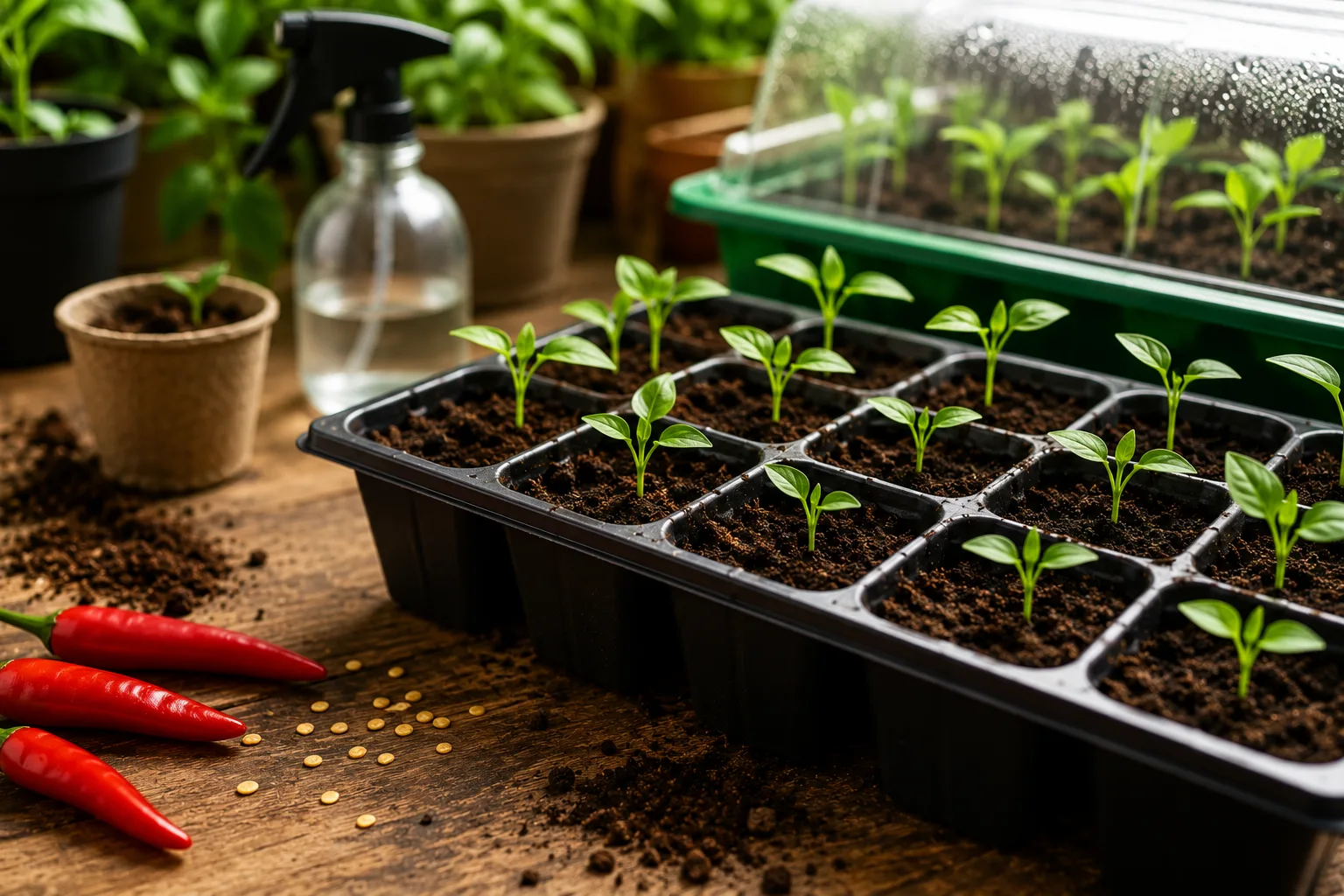
- Pots or seed trays
- Seed starting mix
- Spray bottle
- Heat source
- Proper lighting
- Mini greenhouse (optional but very useful)
Heated propagators greatly improve germination rates and early plant growth.
Which substrate should you use?
The substrate plays an important role during germination.
A good seed starting mix should be:
- light
- well-draining
- fine-textured
- slightly moist
- low in fertilizer
Recommended mix
- 70% seed starting mix
- 20% coco coir
- 10% perlite or vermiculite
A simple fine and light seed starting soil will also work well.
A substrate that is too compact may cause damping-off or prevent young roots from developing properly.
Ideal germination temperature
Heat is probably the most important factor for successful chili seedlings.
Recommended temperatures
| Pepper type | Ideal temperature |
|---|---|
| Capsicum annuum | 22 to 28°C |
| Capsicum chinense | 26 to 30°C |
Below 20°C, germination often becomes slow and irregular.
Average germination time
| Variety | Average time |
|---|---|
| Jalapeño | 5 to 10 days |
| Cayenne | 7 to 14 days |
| Habanero | 10 to 30 days |
| Carolina Reaper | 15 to 40 days |
Patience is essential with some ultra-hot varieties.
Should you soak the seeds?
Soaking seeds before sowing is not mandatory, but it can speed up germination.
Simple method
- Soak the seeds for 12 to 24 hours
- Use lukewarm water (not too hot!)
- Sow immediately afterward
Be careful not to exceed 24 hours to avoid mold issues.
How to sow chili seeds
Step 1: prepare the containers
Fill the pots with slightly moist substrate.
Do not compact the soil too much.
Step 2: sow the seeds
Place 1 to 3 seeds per pot (if more than one seed germinates, keep the strongest plant).
Cover lightly with a few millimeters of substrate.
Ideally, bury the seed at a depth equal to twice its size (around 5 mm).
Step 3: moisten
Gently spray water onto the substrate.
The substrate should remain moist but never waterlogged.
Step 4: provide heat
Place the seedlings in a warm location:
- heated propagator
- heat mat
- warm room
The greenhouse effect provided by propagators will be your best ally, but beware of excess humidity that may rot the seeds.
Step 5: wait for germination
During this phase:
- maintain humidity
- avoid cold temperatures
- avoid intense direct sunlight

Light: an essential factor
Once the seeds germinate, light becomes essential.
Without enough light, young plants may become thin, weak, pale, or leggy.
Possible solutions
- Very bright window
- Sunroom
- LED grow light (allows plants to grow easily even in areas with limited sunlight)
Recommended lighting duration
Ideally, provide 12 to 16 hours of light per day. Some varieties can grow with less light, but growth will be slower.
Grow lights generally provide the best indoor results.
Watering young seedlings
Overwatering is one of the most common mistakes.
Best practices
- Water lightly
- Keep the substrate slightly moist
- Avoid standing water
- Ensure proper drainage
Signs of overwatering
- soft stems
- mold
- damping-off
- yellowing
Common mistakes
Sowing too early
Plants started too early may lack light and become difficult to manage before warm weather arrives.
Lack of heat
Temperatures that are too low drastically slow germination. Below 20°C, a chili seed may remain dormant and never develop.
Lack of light
Plants quickly become leggy and fragile.
Overwatering
Excessive humidity encourages diseases and root or seed rot.
Using poor soil
Heavy or compact substrate limits root development.
When should young plants be transplanted?
Transplanting can begin once plants develop several true leaves.
At this stage:
- roots are stronger
- plants tolerate handling better
- growth accelerates
Transplanting will be covered in detail in our guide dedicated to young chili plants.
FAQ: frequently asked questions
Why are my seeds not germinating?
The most common causes are:
- temperatures too low
- seeds too old
- overwatering
- lack of humidity
How long do chili seeds take to germinate?
Depending on the variety, germination may take anywhere from a few days to several weeks.
Can you sow directly outdoors?
In most temperate climates, this is not recommended. Chili peppers need constant warmth to start properly.
Are grow lights mandatory?
No, but they significantly improve the quality of indoor seedlings.
Conclusion
Successfully starting chili pepper seedlings mainly requires three things: heat, light, and patience.
With a good substrate, proper temperature, and controlled watering, you will quickly obtain vigorous young plants ready to continue growing.
The next steps will be transplanting, acclimatization, and plant care until harvest.